
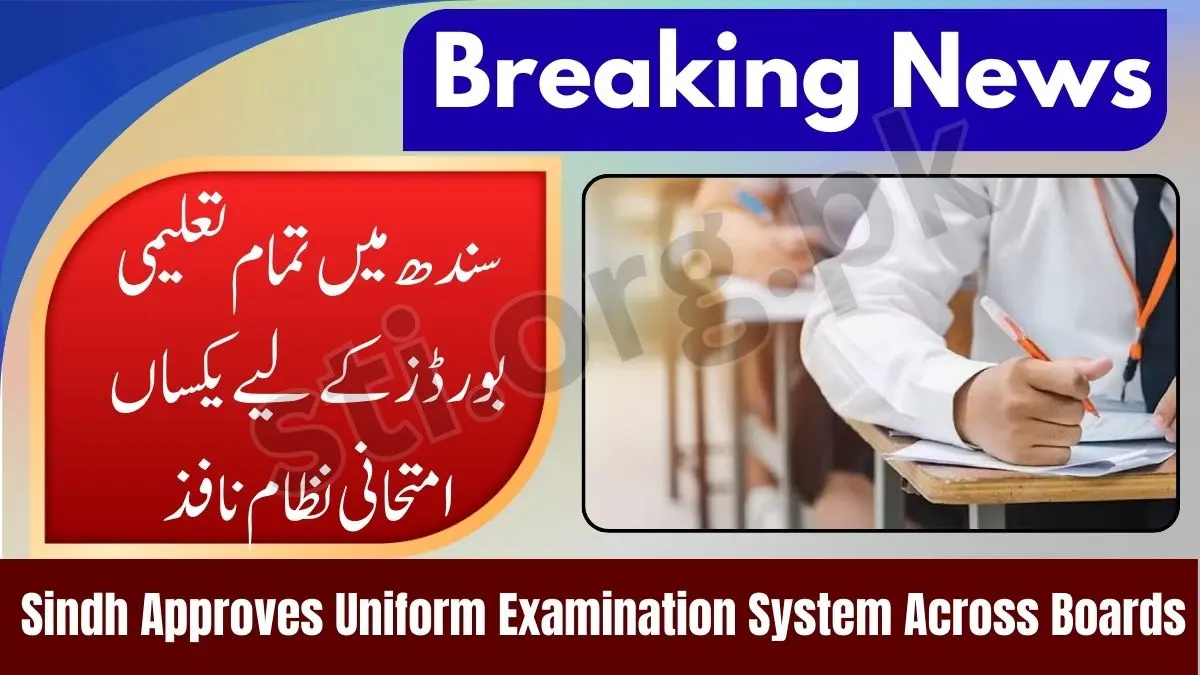
Sindh has officially approved a Uniform Examination System across all education boards, marking one of the most important education reforms in the province’s history. The decision is being widely welcomed by students, parents, teachers, and education experts who have long demanded fairness and consistency in board examinations.
Under this new system, all education boards in Sindh will now follow one syllabus, one paper pattern, and one assessment standard, ensuring that every student is evaluated on equal grounds, regardless of the board they belong to.
The reform has been formally approved by Provincial Education Minister Syed Sardar Ali Shah, while the Sindh School Education Department has issued a No Objection Certificate (NOC) to begin implementation.
This announcement is being described as a game-changer for Sindh’s education system.
What Is the Uniform Examination System?
The Uniform Examination System (UES) means that examinations across Sindh will no longer vary from board to board. Previously, different boards followed different paper patterns, marking styles, and difficulty levels, which often created confusion and inequality.
Under the new system:
- All boards will follow the same approved syllabus
- Question papers will be designed using the same structure
- Difficulty level will remain uniform
- Assessment and marking criteria will be standardized
This reform aims to ensure that talent, not board selection, determines student success.

Implementation Begins With Classes IX and X
According to official details, the Uniform Examination System has been initially implemented for Classes IX and X. These classes were selected as the starting point because matriculation exams play a crucial role in shaping students’ academic futures.
The syllabus and assessment framework were reviewed and finalized after detailed recommendations by the Directorate of Curriculum, Assessment and Research.
Authorities confirmed that:
- Question papers will follow a Table of Specifications
- All boards will prepare papers using the same blueprint
- Topic weightage will remain consistent across Sindh

Subjects Covered Under the New System
In the first phase, the Uniform Examination System will apply to major core subjects, including:
- English
- Mathematics
- Physics
- Chemistry
- Biology
These subjects are considered critical for students planning to pursue science, medical, engineering, and technical education. By standardizing exams in these subjects, the government aims to create equal academic opportunities for all students.

Exams Will Not Be Based Only on Textbooks
One of the most significant changes introduced under the UES is that exams will no longer depend only on textbook memorization.
Education Minister Syed Sardar Ali Shah clearly stated that:
- Exams will test conceptual understanding
- Students will be assessed on application of knowledge
- Critical thinking will be encouraged
This marks a shift away from rote learning and toward modern, outcome-based education, which better prepares students for higher studies and real-life challenges.

Ending the “Easy Board vs Hard Board” Debate
For decades, students in Sindh have faced a common issue: the belief that some boards are easier while others are harder. This perception affected:
- Student confidence
- College admissions
- Merit-based scholarships
With the introduction of a uniform examination system, all boards will now be treated equally. The same syllabus, paper pattern, and difficulty level will apply everywhere, finally putting an end to the long-standing debate.
Education officials believe this will restore public trust in board results and ensure merit-based academic progression.
Transparency and Fairness in Assessment
Transparency is at the heart of this reform. Standardized exams reduce chances of:
- Biased marking
- Unfair paper setting
- Inconsistent assessment
Under the new system:
- Assessment criteria will be clearly defined
- Learning outcomes will be measurable
- Exam results will be more reliable
This will benefit not only students but also colleges, universities, and employers who rely on board results for admissions and selection.
Teacher Training and Classroom Alignment
The Sindh government has acknowledged that exam reforms alone are not enough. For effective implementation, teachers play a central role.
Alongside UES, authorities are focusing on:
- Teacher professional development
- Concept-based teaching methods
- Aligning classroom instruction with exam objectives
Training programs are being strengthened to help teachers adapt to the new assessment style, ensuring students are fully prepared well before exams.
Focus on Student Learning Outcomes
Another key objective of the Uniform Examination System is improving student learning outcomes. Instead of encouraging memorization, the new framework focuses on:
- Understanding concepts
- Applying knowledge
- Analytical thinking
Education experts believe this approach will help students develop skills needed for:
- Higher education
- Competitive exams
- Professional careers
Expansion to Classes XI and XII in Next Phase
For now, the Uniform Examination System applies only to Classes IX and X. However, the Sindh School Education Department has confirmed that:
- Classes XI and XII will be included in the next phase
- Further evaluation by DCAR is underway
- A phased rollout will ensure smooth transition
Officials say this careful expansion will allow the government to address challenges and improve the system before extending it to higher secondary education.
Why This Reform Matters
This reform is important because it:
- Creates equal opportunities for all students
- Improves credibility of board examinations
- Reduces academic discrimination
- Aligns Sindh’s education system with modern standards
For years, students have demanded fairness in exams. This decision directly responds to those concerns.
Public Reaction and Expectations
The announcement has sparked widespread discussion across social media, with many students welcoming the move. Parents and teachers have also expressed hope that this system will:
- Reduce stress among students
- Provide clear exam direction
- Improve overall education quality
However, experts also stress the need for strict monitoring and continuous improvement to ensure successful implementation.
A Step Toward Future-Ready Education
The Sindh government believes that the Uniform Examination System will lay the foundation for a future-ready education system. By focusing on understanding rather than memorization, students will be better prepared for:
- College and university education
- Professional training
- Global academic standards
Education Minister Syed Sardar Ali Shah expressed confidence that this reform will help build a strong, transparent, and credible examination system in the province.
Conclusion – Uniform Examination System Across Boards
The approval of a Uniform Examination System across all Sindh education boards is a historic and bold decision. By standardizing exams, promoting fairness, and focusing on real learning, Sindh has taken a major step toward improving its education system.
With implementation starting from Classes IX and X and plans to expand further, this reform has the potential to benefit millions of students and reshape the academic future of the province.