
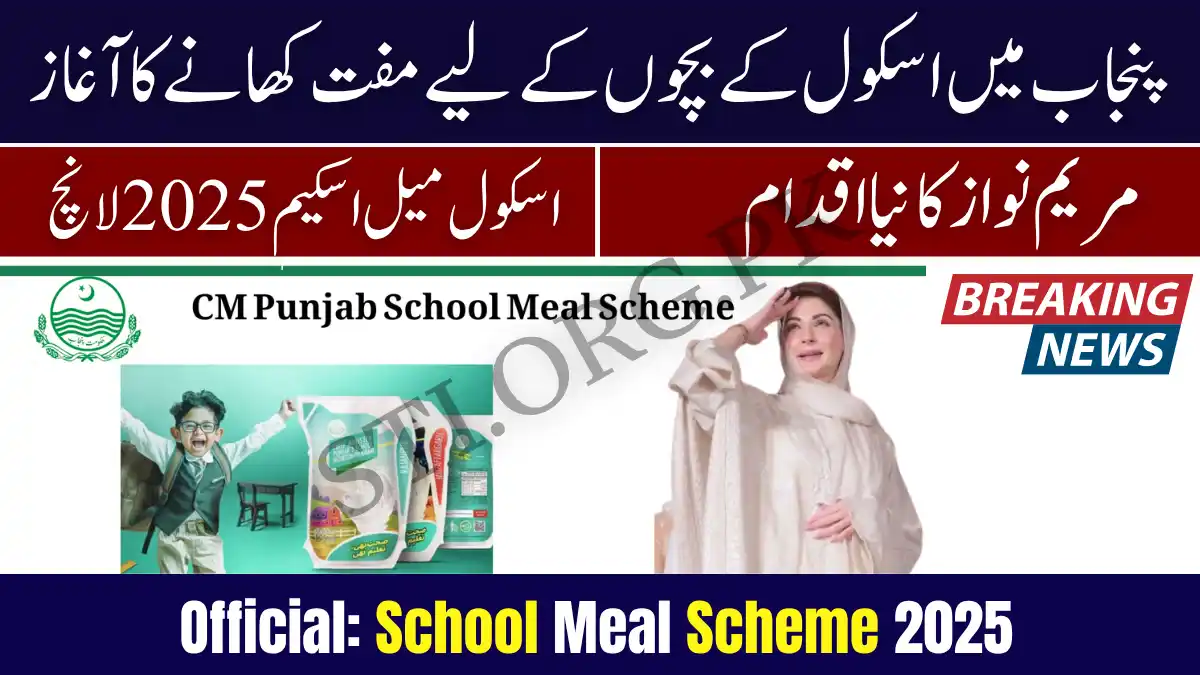
The School Meal Scheme 2025 launched by Chief Minister Maryam Nawaz Sharif, marks a transformative step in Punjab’s journey toward eradicating classroom hunger and promoting education through nutrition. This initiative ensures that every child—especially in underprivileged and rural areas—receives a healthy meal daily while attending school.
Designed under the Punjab School Nutrition Program, the CM School Meal Scheme 2025 aims to create a hunger-free, healthy, and educated generation. It starts from the southern districts of Rajanpur, Muzaffargarh, and Dera Ghazi Khan, gradually expanding to the entire province within a year.
What Is the School Meal Scheme 2025?
The School Meal Scheme 2025 is a government-funded nutrition and education support program under Punjab’s Education and Health Vision 2025. Its main goal is to provide free, nutritious meals to school-going children, particularly in low-income and food-insecure areas.
This initiative aligns with the UN Sustainable Development Goals (SDGs) for “Zero Hunger” and “Quality Education,” ensuring every child receives adequate nourishment to support both physical and mental growth.
The meals will be distributed daily in government primary and middle schools, with initial coverage of 400,000 students in the first phase. The program will later expand to secondary and special education schools across Punjab.
Purpose and Vision of the CM School Meal Scheme
The Punjab government recognizes that a hungry child cannot learn effectively. Many children, especially in rural areas, attend school on an empty stomach, which impacts their concentration, attendance, and academic performance.
The School Meal Program seeks to address this issue by:
- Improving school attendance and retention rates.
- Combating child malnutrition and stunted growth.
- Encouraging female enrollment by easing family financial burdens.
- Promoting nutrition awareness among parents and students.
- Fostering community involvement in building a healthy future generation.
By linking nutrition with education, the scheme creates a long-term foundation for an educated and healthy Punjab.

Key Features of the School Meal Scheme 2025
| Feature | Description |
|---|---|
| Target Group | Government primary and middle school students |
| Coverage (Phase 1) | 400,000 students in Rajanpur, Muzaffargarh & Dera Ghazi Khan |
| Future Coverage | All 36 districts of Punjab by 2026 |
| Meal Type | Daily fresh, balanced meals designed by nutrition experts |
| Program Duration | Continuous, with quarterly nutritional reviews |
| Sustainability Focus | Use of recyclable packaging & local food sourcing |
| Launch Date | September 2025 |

Why the School Meal Scheme Matters
The School Feeding Program directly addresses two pressing challenges in Punjab’s education system—malnutrition and dropout rates.
According to UNICEF data, over 40% of Pakistani children under 12 suffer from stunting or nutrient deficiency. Many of these children come from families that struggle to afford daily meals, let alone nutritious ones.
By providing free, balanced meals, this program:
- Improves children’s physical and cognitive development.
- Helps students focus better in class and perform well academically.
- Reduces absenteeism and increases regular attendance.
- Relieves parents of daily food-related worries.
- Creates a positive, inclusive learning environment in schools.
Read More: Latest Punjab Launches Free Health Screening & Skills Program 2025
Objectives of the School Meal Scheme 2025
The Punjab government has outlined clear objectives for this initiative:
1. Provide Daily Nutritious Meals
Children will receive meals rich in energy and nutrients, including proteins, carbohydrates, vitamins, and minerals, essential for healthy growth.
2. Reduce Financial Pressure on Families
Low-income families often struggle to provide breakfast or lunch for their children. This program ensures that every child receives at least one guaranteed nutritious meal every day.
3. Promote Gender Equality
The program is expected to increase girls’ enrollment in schools, as providing free meals reduces household expenses and encourages parents to educate daughters.
4. Build a Healthier Future Generation
The initiative supports Punjab’s long-term goal of reducing malnutrition, improving literacy, and ensuring every child gets the opportunity to thrive.
What’s on the Menu?
Meals under the Punjab School Meal Scheme are designed by nutrition experts and meet international standards of school feeding programs.
Each meal includes:
- Grains and Energy Foods: Rice, chapati, or fortified cereal.
- Protein Sources: Boiled eggs, lentils, or chicken portions.
- Fruits and Vegetables: Bananas, oranges, apples, or mixed salads.
- Dairy Products: Milk packs or yogurt for calcium and vitamins.
- Safe Drinking Water: Filtered and clean water provided with meals.
The menu will rotate weekly to maintain variety and encourage children to eat healthy every day.
Distribution and Monitoring Process
The Punjab Education Department and Health & Nutrition Division jointly manage meal distribution across all schools.
Meal Delivery Process:
- Meals prepared by licensed local vendors or community kitchens under hygienic conditions.
- Daily supply chain monitored via digital tracking and school records.
- Teachers oversee meal distribution during lunchtime.
Monitoring & Evaluation:
- District Education Officers will inspect schools regularly.
- Random food safety testing to ensure hygiene and nutrition.
- Monthly progress reports submitted to the Chief Minister’s Secretariat.
- Feedback channels for parents and students via the official helpline and mobile app (to be launched in 2026).
Environmental Responsibility – Green Punjab Policy
The School Meal Scheme 2025 supports Punjab’s Green Policy by promoting environmental sustainability.
- Over 1.3 crore milk bags used per month will be recycled.
- Meals packaged in biodegradable containers.
- Food waste will be minimized through planned meal portions.
- Local farmers will supply grains, vegetables, and dairy, boosting Punjab’s rural economy.
This integration of sustainability with education and nutrition reflects the government’s modern governance approach.
Benefits of the School Meal Scheme
For Students
- Improved academic performance and classroom participation.
- Better growth, immunity, and concentration levels.
- Reduced hunger and fatigue during school hours.
For Families
- Relief from daily meal expenses.
- Increased motivation to send children, especially daughters, to school.
For Society
- Enhanced literacy and education rates.
- Lower school dropout rates across Punjab.
- Promotion of social equality and poverty reduction.
Challenges and Government Solutions
While the School Nutrition Initiative is ambitious, certain challenges may arise during implementation.
Funding & Resources:
To sustain the daily meal supply, the government is engaging private partners and international donors such as UNICEF, WFP, and local NGOs.
Logistics & Remote Access:
For rural and hard-to-reach schools, the Punjab government will use mobile kitchen vans and community kitchens.
Food Safety:
Strict hygiene protocols and digital monitoring will ensure that all meals meet health standards.
Transparency:
The scheme is backed by a digital audit system—each meal batch will be tracked from preparation to delivery.
Read More: Latest Update: Punjab Dialysis Card 2025
How to Apply for the School Meal Scheme 2025
Parents or guardians do not need to pay any fees to enroll their children. Enrollment is automatic for students attending government schools under the covered districts.
However, schools maintain a registration list to track meal distribution.
For New Enrollments:
- Visit your child’s government primary or middle school.
- Ask for the School Meal Scheme registration form.
- Fill in student details (name, age, class, and CNIC/B-Form number).
- Submit to the school head or class teacher.
- Wait for confirmation SMS from the Punjab Education Department.
Once enrolled, your child will start receiving daily meals as per the school’s schedule.
Expansion Plans and Future Vision
The Punjab School Meal Scheme is currently operational in three districts but will soon cover all public schools across Punjab.
Phase 1 (2025): Rajanpur, Dera Ghazi Khan, Muzaffargarh
Phase 2 (2026): Bahawalpur, Sahiwal, Kasur, and Vehari
Phase 3 (2027): Entire province, including remote areas of South Punjab
Additionally, the government aims to integrate nutrition education sessions into the school curriculum—teaching students about healthy eating habits and food hygiene.
A dedicated mobile app and online dashboard will also launch to allow parents and teachers to monitor meal quality and attendance.
CM Maryam Nawaz’s Statement on the Launch
During the inauguration ceremony, CM Maryam Nawaz Sharif said:
“No child in Punjab should go to school hungry. Education and nutrition go hand in hand, and through the School Meal Scheme 2025, we are investing not only in classrooms but in the health of our children—the true future of Punjab.”
Her statement reflects the government’s strong commitment to ensuring equal opportunities for every child in the province.
FAQs – School Meal Scheme 2025
Q1: Which schools are included in the first phase?
The scheme currently covers government primary and middle schools in Rajanpur, Dera Ghazi Khan, and Muzaffargarh.
Q2: Are private schools eligible?
No, the program is currently limited to government schools only.
Q3: Will students need to pay any fees?
No. The scheme is completely free for all eligible students.
Q4: How is food quality maintained?
Meals are prepared under hygienic conditions and regularly inspected by food safety teams and independent auditors.
Q5: Will this program expand to other provinces?
The Punjab government is collaborating with federal authorities to share the model for possible replication nationwide.
Q6: How will the government ensure long-term success of this program?
The Punjab government has set up continuous monitoring and feedback systems to ensure the scheme remains sustainable and effective for years to come.
Q7: Can parents give feedback about meal quality?
Yes. Parents can share feedback through the official helpline or mobile app, which helps improve meal quality and overall management.
Conclusion
The School Meal Scheme 2025 is a groundbreaking initiative that combines education, health, and social welfare under one umbrella. By feeding hungry children, Punjab is not only improving school attendance but also nurturing a healthier, more intelligent, and compassionate generation.
This program ensures that every child, regardless of background, has an equal chance to learn, grow, and dream—on a full stomach. It’s more than just a meal; it’s the beginning of a better, brighter Pakistan.