
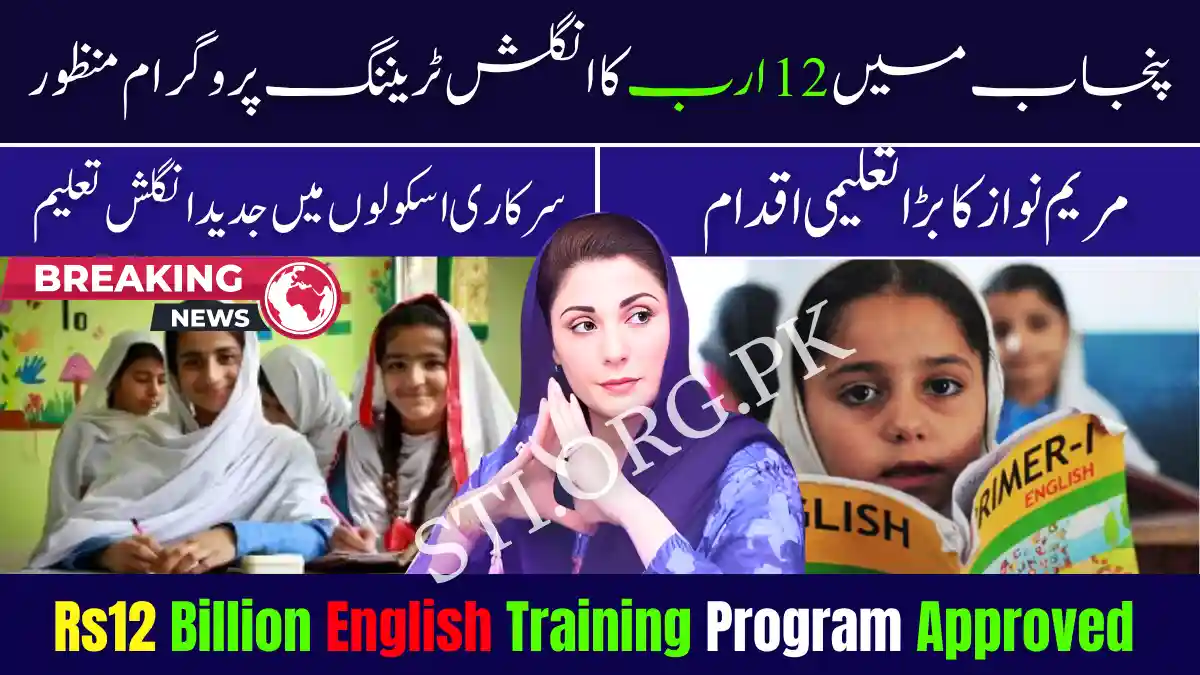
The Punjab government has officially approved the Rs12 Billion English Training Program, a landmark education reform designed to revolutionize English learning standards in public schools across the province. With an ambitious investment of Rs 12 billion, this program aims to uplift both students and teachers by introducing international-standard training, modern digital tools, and an updated curriculum to close the long-standing gap between public and private institutions.
This Rs12 Billion English Training Program represents a forward-thinking vision by Chief Minister Maryam Nawaz Sharif to ensure that students in government schools receive the same quality of English education that private institutions offer. The initiative focuses on English language proficiency, digital inclusion, and skill development for the next generation of Pakistani youth.
Government’s Vision Behind the Rs12 Billion English Training Program
Chief Minister Maryam Nawaz has prioritized education reform as a pillar of her administration. Through this Government Education Scheme, she intends to create a level playing field for public-school students by improving English fluency, comprehension, and communication skills. The initiative will also prepare students for higher studies, international scholarships, and job opportunities that demand English proficiency.
This visionary move underlines Punjab’s commitment to modernize its public education system. The Rs12 Billion English Training Program Approved for Punjab Students 2025 aims to transform how English is taught and learned — replacing outdated memorization methods with practical, interactive, and technology-driven approaches.
Core Objectives of the English Training Initiative
The new Teacher Training Initiative will not only enhance teaching quality but also reshape the entire learning environment within government institutions. The objectives are both immediate and long-term, ensuring systemic reform across all educational levels.
| Objective | Description |
|---|---|
| Improve English Proficiency | Strengthen speaking, writing, reading, and listening skills among students and teachers. |
| Modernize Curriculum | Align Punjab’s English curriculum with CEFR and Cambridge standards. |
| Train Teachers | Provide continuous professional development and global certification opportunities. |
| Introduce Technology | Use AI-powered pronunciation labs, smart classrooms, and digital applications. |
| Strengthen Confidence | Enable students to communicate effectively in academic and professional environments. |
This comprehensive plan reflects the province’s goal of creating an inclusive, skill-oriented, and globally competitive education system.

Why Punjab Needs This English Upgrade
The English Language Proficiency gap between private and public school students has long been a concern for parents and educators. Private schools have consistently held an advantage due to English-medium instruction, leaving government-school students behind in university admissions, job interviews, and scholarship tests.
The Rs12 Billion English Training Program seeks to end this disparity by making high-quality English learning accessible to everyone. It also supports Pakistan’s broader strategy for student skill development and workforce readiness under the national education framework.
By enhancing comprehension, writing, and pronunciation standards, Punjab aims to equip its students for both local and global opportunities — from higher education to international employment.

Key Components of the Program
The Rs12 Billion English Training Program Approved for Punjab Students 2025 will run under the supervision of the Punjab School Education Department (SED). Its design combines traditional teaching improvements with modern technology and performance evaluation systems.
Major Components
- Curriculum Enhancement Program – English textbooks and learning materials will be updated to match international benchmarks.
- Digital Learning Tools – Smart classrooms, e-books, and pronunciation apps will modernize the learning experience.
- Teacher Certification – Educators will undergo professional certification through partnerships with British Council and language universities.
- AI-Powered Labs – Advanced language labs will help improve speaking and accent skills.
- Annual Assessments – Continuous testing will measure progress and identify training gaps.
This integrated model ensures equal focus on both students and teachers, enabling a self-sustaining cycle of quality education.
Read Also: Punjab Free Tablets for Punjab Students 2025

Implementation Plan and Budget Distribution
The Punjab government has approved a phased rollout of the Student Skill Development initiative to ensure effective implementation and monitoring.
| Component | Description | Budget Allocation (Rs) | Timeline |
|---|---|---|---|
| Teacher Training Workshops | Capacity building and global certification | 4 Billion | Phase 1 (2026 Q1–Q2) |
| Student Learning Modules | Classroom and digital learning material | 3 Billion | Phase 2 (2026 Q3–Q4) |
| Digital Tools & Apps | Smart classrooms and AI-based tools | 2 Billion | Phase 3 (2027 Q1) |
| Curriculum Development | Textbook modernization | 1 Billion | Continuous |
| Monitoring & Evaluation | Performance tracking and audits | 2 Billion | Annual |
This phased investment ensures sustainability and accountability in every phase of execution.
Focus on Students and Teachers
Student-Centered Learning
The program promotes an interactive approach, replacing rote memorization with activity-based learning. Students will participate in debates, creative writing sessions, comprehension games, and oral communication activities. This method enhances confidence and fluency, preparing students for real-world communication challenges.
Teacher Development and Professional Growth
The Teacher Training Initiative is a cornerstone of the program. Teachers will undergo training through workshops and online certification courses developed in collaboration with international education bodies. The training will include modules on grammar, phonetics, lesson planning, and feedback techniques.
Once certified, teachers will serve as English mentors within their schools, ensuring knowledge transfer and continued excellence.
Digital Integration and Technological Tools
Punjab’s Curriculum Enhancement Program emphasizes digital transformation in classrooms. Through the use of e-learning platforms, AI tools, and smart boards, the province aims to bridge the urban-rural divide in education quality.
Digital features include:
- Learning Management Systems (LMS) for student tracking.
- AI-based pronunciation correction apps.
- E-classrooms connecting rural schools to city-based experts.
- Audio-visual content for improving listening comprehension.
This digital inclusion ensures that every student, regardless of background, receives equal exposure to global education standards.
Monitoring, Evaluation, and Transparency
A central digital dashboard will monitor all aspects of the Rs12 Billion English Training Program — from teacher participation to student performance. Each district’s progress will be tracked by the Punjab Education Sector Reform Unit (PESRU) to maintain quality and consistency.
Independent evaluations will be conducted annually to measure outcomes and identify areas of improvement. These evaluations will also ensure that funds are properly utilized and that schools meet proficiency benchmarks set under the Government Education Scheme.
Global Collaborations and Benchmarking
To ensure international credibility, Punjab has partnered with globally recognized institutions. Collaborations are in progress with:
- British Council Pakistan
- Cambridge Assessment International Education
- US Education Foundation (USEFP)
- Allama Iqbal Open University (AIOU) for distance learning
These partnerships bring world-class teaching standards, modern methodologies, and internationally recognized certifications to Punjab’s education sector.
The Rs12 Billion English Training Program Approved for Punjab Students 2025 takes inspiration from successful models implemented in countries like Malaysia and Singapore, where government schools achieved global recognition through English-language proficiency programs.
Expected Benefits of the Rs12 Billion English Training Program
Benefits for Students
| Area | Impact |
|---|---|
| Communication | Improved spoken English and confidence |
| Academic Success | Better performance in board exams and tests |
| Global Opportunities | Eligibility for international scholarships and jobs |
| Personality Development | Enhanced critical thinking and creativity |
Benefits for Teachers
| Area | Impact |
|---|---|
| Certification | Opportunity for globally recognized teaching credentials |
| Career Growth | Higher promotion prospects in the education sector |
| Teaching Tools | Access to modern digital aids and online materials |
| Classroom Quality | Improved teaching efficiency and student engagement |
This dual-impact strategy strengthens both sides of the learning process, ensuring consistent progress across Punjab’s education network.
Challenges and Solutions
While the program’s potential is immense, implementation requires careful planning. Common challenges include infrastructure limitations in rural schools, teacher absenteeism, and inconsistent internet access.
To overcome these, the government has established clear strategies:
- Mandatory attendance systems with biometric verification for teachers.
- Solar-powered IT labs in rural areas to ensure uninterrupted learning.
- Centralized monitoring through real-time digital dashboards.
These solutions guarantee that the Punjab Public Schools Reform remains efficient, transparent, and sustainable.
Comparison: Current vs Future System
| Feature | Before Program | After Implementation |
|---|---|---|
| Teaching Medium | Predominantly Urdu | Balanced English-medium modules |
| Student Learning | Rote memorization | Interactive, activity-based learning |
| Teacher Training | Irregular workshops | Continuous online certification |
| Digital Resources | Minimal use | Smart boards, LMS, and apps |
| Global Recognition | Local curriculum only | Linked with CEFR and Cambridge benchmarks |
This transition positions Punjab as a leader in education innovation and digital transformation in South Asia.
Expert and Public Response
Education experts have praised the initiative as one of the most visionary reforms in Pakistan’s history. Dr. Hina Ali, a senior educationist at Punjab University, stated that “this Rs12 Billion English Training Program is a game changer that will finally bridge the language divide between private and public schools.”
Economists predict that improved English literacy could increase employability rates by up to 20 percent, especially in growing sectors like IT, freelancing, and tourism. Parents and students alike have welcomed the move, viewing it as a long-overdue step toward global competitiveness.
Read Also: CM Punjab Laptop Scheme Phase-2 2025
FAQs
Q1. What is the Rs12 Billion English Training Program 2025?
It’s a government initiative to upgrade English language proficiency in Punjab’s public schools through modern teaching tools, digital apps, and international curriculum.
Q2. Who will benefit from this program?
Both students and teachers in government institutions across all districts of Punjab will benefit.
Q3. When does the program start?
The rollout begins in early 2026, with pilot projects in selected districts before province-wide expansion.
Q4. What organizations are involved?
Partners include the Punjab School Education Department, British Council Pakistan, AIOU, and international education boards.
Q5. How will it help students?
Students will gain improved English fluency, confidence, and better performance in exams and interviews.
Q6. Will teachers receive certifications?
Yes, teachers will get globally recognized certificates after completing professional training courses.
Q7. Is technology part of the initiative?
Yes, smart classrooms, AI labs, and e-learning tools are integral parts of the program.
Q8. How will the program ensure transparency?
A digital dashboard managed by PESRU will track every district’s progress and spending for accountability.
Conclusion
The Rs12 Billion English Training Program Approved for Punjab Students 2025 marks a historic step toward educational transformation. By integrating technology, teacher training, and global-standard curriculum, the Punjab government is building a future-ready generation equipped with strong English communication and digital skills.
This Rs12 Billion English Training Program not only bridges the public-private education gap but also enhances Pakistan’s global competitiveness. If implemented effectively, it will empower millions of students and teachers, turning Punjab’s classrooms into centers of confidence, knowledge, and opportunity.