
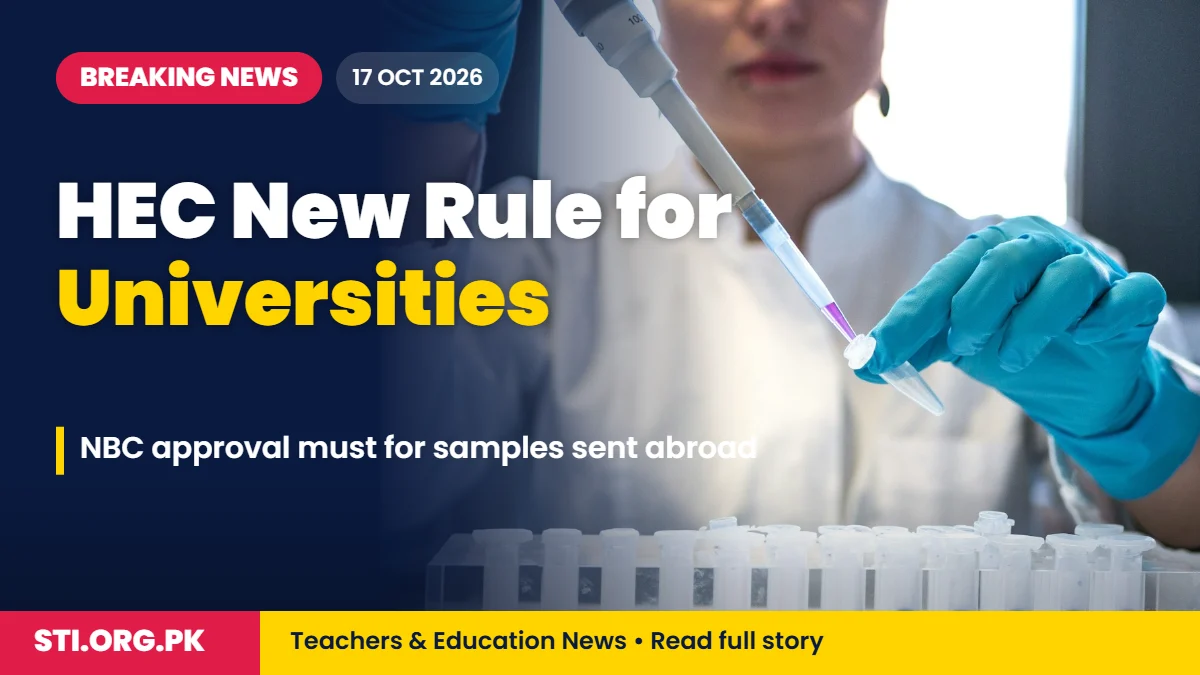
The Higher Education Commission has issued a new instruction that makes HEC bioethics approval compulsory for universities that want to send human biological samples or health data to other countries. Under the directive, universities and degree-awarding institutions must first obtain written clearance from the National Bioethics Committee (NBC) before any such transfer.
The rule affects researchers, faculty members and postgraduate students who work on joint projects with foreign institutions. Here is a simple explanation of the new requirement and what it means for universities research rules in Pakistan.
What the HEC Bioethics Approval Rule Says
According to the directive, institutions must get NBC approval in writing before sharing biological samples abroad. The materials covered include:
- Blood samples.
- Human tissues.
- DNA and RNA.
- Human cells.
- Health-related data of Pakistani citizens.
Universities must also fully follow the NBC’s rules on handling biological material and health information.

Why HEC Introduced This Requirement
HEC has given two main reasons for the new rule.
National Security and Genetic Resources
The commission warned that sending biological material abroad without authorisation could create national security risks and weaken the protection of Pakistan’s genetic resources. Genetic data is valuable, and countries around the world now treat it as a sensitive national asset.
Health Data Privacy
HEC also raised concerns about health data privacy. Unregulated sharing of medical records or genetic information could expose the personal details of Pakistani citizens. The new rule is meant to make sure that people who give samples for research are protected.
Also read

Latest News: Punjab Textbook Shortage Fears Grow as Tenders for Grades 1 to 5 Remain Pending
Penalties for Non-Compliance
The commission has made it clear that the HEC bioethics approval rule is not optional. Institutions that ignore the rule may face regulatory action from HEC. More importantly for researchers, approvals for ongoing and future research projects can be withdrawn if NBC clearance is not obtained. This means a project could be stopped midway if the correct permission was not taken.
Also read

Latest News: Punjab Announces New Non-Formal Schools Timings – 8:45 AM to 12:45 PM Till March 2027
What HEC Bioethics Approval Means for Faculty and Students
The HEC bioethics approval requirement will change how many research teams work. For university teachers and research students, the message is clear: plan ahead. Any study that involves sending samples or patient data to a foreign lab or partner university now needs extra time for NBC review.
Practical Steps for Researchers
- Check whether your project involves any transfer of samples or health data outside Pakistan.
- Contact your university’s ethics review board early to start the NBC process.
- Keep consent forms, data protection plans and material transfer agreements ready.
- Do not ship samples or share data until written approval is received.
- Inform foreign collaborators about the new timeline so that the project schedule is realistic.
Also read

Latest Jobs: Malir University Jobs 2026 – Faculty and Staff Needed for New Malir Medical College
How Universities Should Respond
Universities should now update their internal research policies to include the HEC bioethics approval step. Ethics review boards may need to train staff, set clear timelines and keep a record of every sample or dataset sent outside the country. Graduate schools can also brief MPhil and PhD students, many of whom work on joint projects with foreign supervisors, so that no thesis work is delayed because of missing paperwork.
Medical and life sciences departments will be the most affected, but social science researchers who collect health surveys may also fall under the rule if the data is shared abroad.
Impact on International Research Collaboration
Some researchers worry that extra paperwork could slow down international projects. However, many countries already have similar rules, and clear procedures can actually build trust with foreign partners. If the approval process is quick and transparent, the requirement for HEC bioethics approval could strengthen Pakistan’s research reputation rather than weaken it.
In the long run, a well-run approval system can protect participants, give researchers legal certainty and help Pakistani universities negotiate fairer terms with foreign partners over the use of local data.
Frequently Asked Questions
What is the new HEC rule about biological samples?
Universities must get written approval from the National Bioethics Committee before sending human biological samples or health data abroad.
Which materials are covered?
Blood, tissues, DNA, RNA, human cells and health-related data.
What happens if a university does not comply?
It may face regulatory action, and approvals for its ongoing or future research projects can be revoked.
Source: ProPakistani report
Also Read: Today News: Dalda Foundation Scholarship 2026 Opens for Students Across Pakistan | Latest Jobs: FAST University Faculty Jobs 2026 in Islamabad, Lahore and Karachi | 3 Pakistani Students Fail to Return After Completing PhDs on HEC Scholarships