

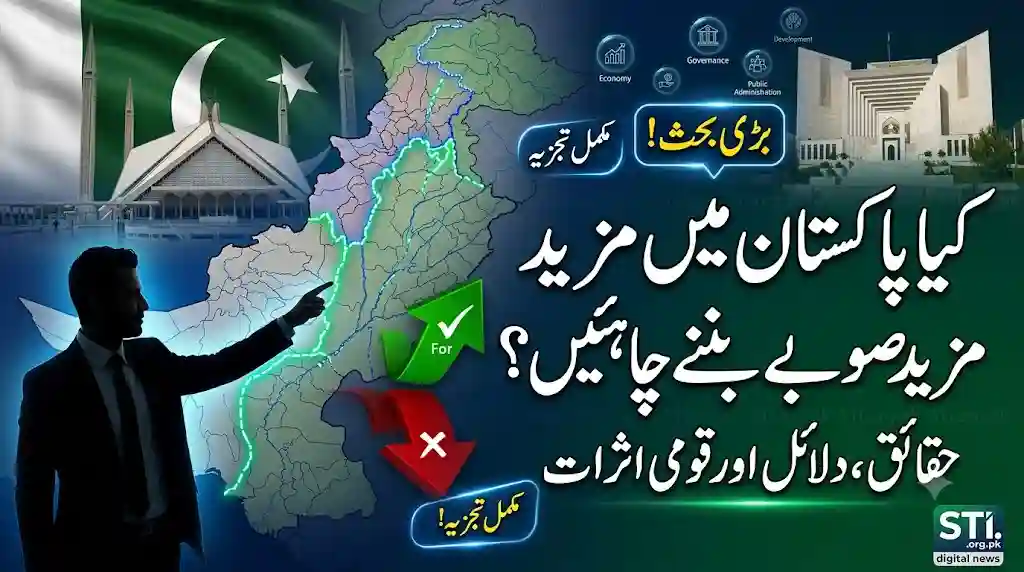
Pakistan is currently divided into four provinces — Punjab, Sindh, Khyber Pakhtunkhwa, and Balochistan — along with the federal capital territory of Islamabad, Azad Jammu and Kashmir, and Gilgit-Baltistan. For decades, the debate over creating new provinces in Pakistan has resurfaced in political discourse, driven by demands from regions such as South Punjab, Hazara, Bahawalpur, and parts of Sindh and Balochistan. This article explores the facts, arguments, and potential national impact of restructuring Pakistan’s provincial map.
The Historical Background
Pakistan’s current provincial boundaries largely trace back to British-era administrative divisions, inherited at independence in 1947 and later reorganized after the 1970 dissolution of the “One Unit” scheme, which had merged all of West Pakistan into a single province. Since then, the four-province structure has remained largely unchanged, even as population, economic activity, and political consciousness in different regions have grown dramatically. Punjab alone, for instance, is home to over half of Pakistan’s population, making it disproportionately large compared to the other three provinces combined in terms of representation and resource allocation.
This imbalance has fueled persistent calls for administrative reforms, particularly the creation of new provinces that would allow for more localized governance and a fairer distribution of resources under mechanisms like the National Finance Commission (NFC) Award.
Key Demands for New Provinces
Several specific proposals have dominated the new provinces in Pakistan debate:
South Punjab Province: Perhaps the most prominent demand, this movement seeks to carve out the Seraiki-speaking belt of southern Punjab — including Multan, Bahawalpur, and Dera Ghazi Khan divisions — into a separate province. Proponents argue that South Punjab has been historically underdeveloped despite its agricultural output, and that political power in Punjab remains concentrated in Lahore and central Punjab.
Bahawalpur Province: A related but distinct demand calls for restoring the former princely state of Bahawalpur to its pre-1955 provincial status, citing its historical identity and a 1970s-era legal precedent.
Hazara Province: In Khyber Pakhtunkhwa, the Hindko-speaking Hazara region has long sought separation, partly due to linguistic and cultural differences from the Pashtun-majority areas of the province, and partly due to political tensions following the renaming of the North-West Frontier Province to Khyber Pakhtunkhwa in 2010.
Karachi or a Muhajir Province in Sindh: Some political voices, particularly from urban Sindh, have floated the idea of a separate administrative unit for Karachi, given its status as Pakistan’s largest city and economic hub, though this remains one of the most politically sensitive proposals due to Sindhi nationalist opposition.
South Balochistan: Smaller movements have also proposed splitting Balochistan into northern and southern administrative units, citing the province’s vast geography and difficulty of governance from a single provincial capital.
Arguments in Favor of Creating New Provinces
Supporters of provincial reorganization make several key points:
- Better governance and administration: Smaller provinces are often easier to govern efficiently, with shorter distances between citizens and provincial government offices, potentially improving service delivery in health, education, and infrastructure.
- Fairer resource distribution: Because NFC Award allocations and Senate representation are partly tied to provincial status, new provinces could mean more direct funding and political voice for historically marginalized regions like South Punjab.
- Reduced political dominance of Punjab: Since Punjab holds the largest share of National Assembly seats, breaking it into smaller units could rebalance Pakistan’s federal political structure and ease long-standing grievances from smaller provinces about Punjab’s outsized influence.
- Recognition of linguistic and cultural identity: Regions like Hazara and the Seraiki belt have distinct languages and cultural identities that many residents feel are not adequately represented within their current provincial setups.
- Precedent of successful reorganization: Supporters often point to the 2018 merger of the Federally Administered Tribal Areas (FATA) into Khyber Pakhtunkhwa as evidence that major administrative restructuring is achievable and can bring underdeveloped regions into the mainstream governance and development framework.
Arguments Against Creating New Provinces
Opponents raise equally serious concerns:
- Financial and administrative costs: Establishing a new province requires building an entirely new bureaucratic apparatus — a provincial assembly, secretariat, high court bench, police force, and administrative departments — which is expensive and could strain already limited public finances.
- Risk of increased ethnic and political tension: Redrawing provincial boundaries, especially along linguistic or ethnic lines, could deepen identity-based politics and create new sources of conflict, particularly in ethnically mixed regions like Karachi.
- Constitutional complexity: Creating a new province requires a constitutional amendment under Article 239, which needs a two-thirds majority in both houses of parliament as well as approval from the relevant provincial assembly — a high bar that has historically stalled most proposals.
- Political resistance from existing power structures: Provincial governments, particularly Punjab’s, have historically resisted losing territory and political weight, since it would reduce their share of National Assembly seats and resources.
- Uncertain impact on development: Critics argue that the real problem is not the number of provinces but poor governance, corruption, and weak local government systems — and that simply creating new administrative units without addressing these root causes may not meaningfully improve service delivery.
The National Impact
The impact of creating new provinces in Pakistan would extend far beyond regional administration. It would reshape the composition of the Senate, alter NFC Award formulas, and potentially set a precedent that other regions could invoke to pursue their own demands. Some analysts argue this could lead to a more balanced federation, reducing the sense of alienation felt by smaller and economically disadvantaged regions. Others warn it could open a Pandora’s box of competing demands that strain national unity, particularly at a time when Pakistan already faces significant economic and security challenges.
Political parties remain divided on the issue. Some have historically supported the South Punjab province demand as part of their electoral platforms, while others have used it more as a bargaining tool during elections rather than pursuing it as serious policy. Achieving genuine provincial reorganization would require sustained political consensus — something that has proven elusive so far.
Should Pakistan Create More Provinces Conclusion
The question of whether Pakistan should create more provinces sits at the intersection of governance efficiency, historical grievance, ethnic identity, and constitutional feasibility. There are compelling arguments on both sides: better local governance and fairer representation versus financial cost, administrative complexity, and the risk of deepening ethnic divisions. Ultimately, any decision on new provinces in Pakistan will require careful constitutional processes, broad political consensus, and a clear-eyed assessment of whether restructuring provincial boundaries would genuinely improve governance — or simply add another layer of bureaucracy without resolving the underlying issues of resource distribution and local representation.