
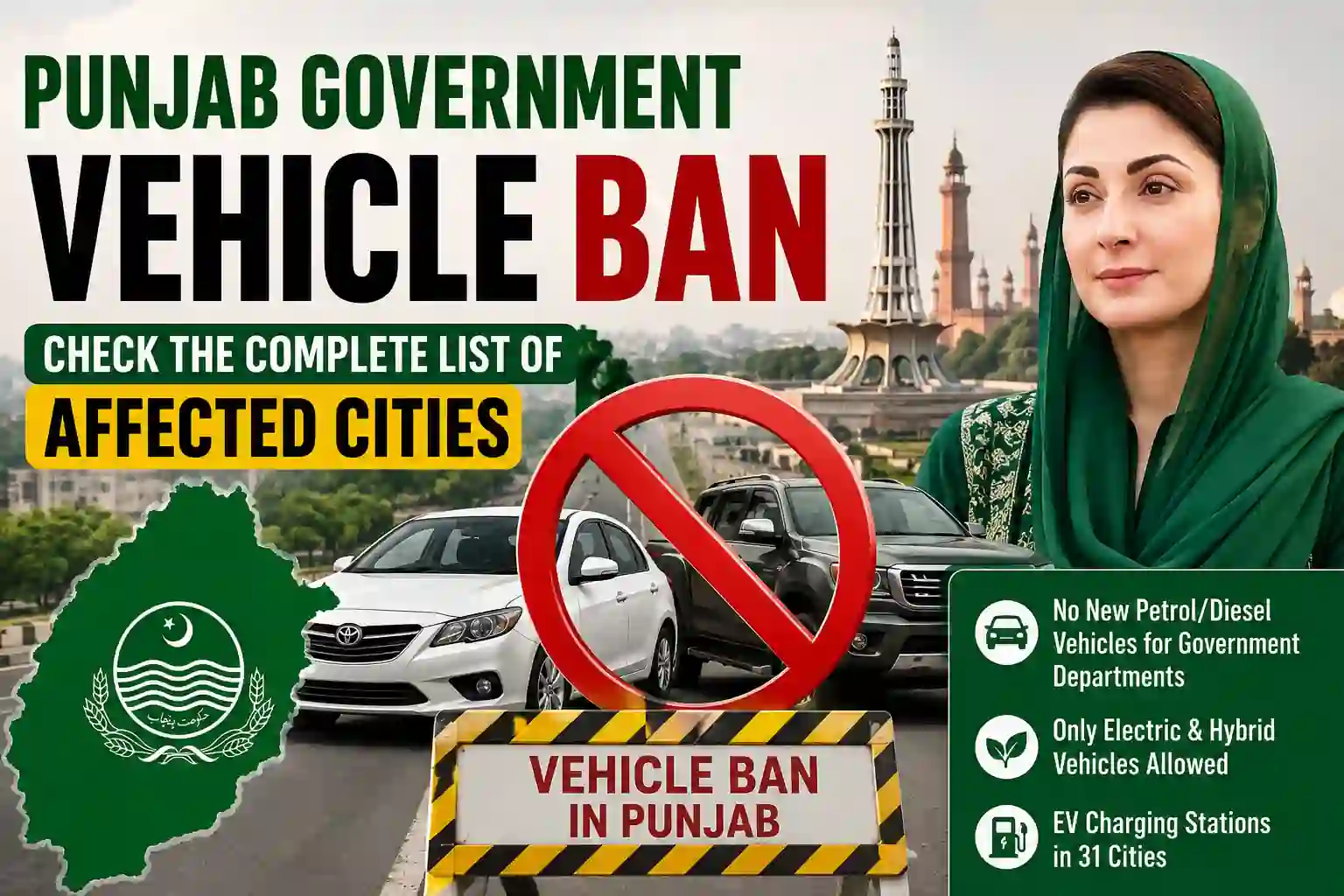
The Punjab Government has announced a series of measures aimed at reducing air pollution, promoting clean transportation, and accelerating the shift toward electric vehicles (EVs) across the province. As part of the latest policy decisions, the government has restricted the purchase of new petrol and diesel vehicles for government departments while introducing stricter environmental regulations in several major cities.
Many people have misunderstood these announcements as a complete ban on all private vehicles. However, the latest official notification clarifies that the restrictions mainly apply to government departments, environmental compliance, and the implementation of the Punjab New Energy Vehicle (NEV) Policy 2026.
In this article, you will find everything you need to know about the latest Punjab Government Vehicle Ban, the affected cities, official notifications, and what these changes mean for vehicle owners across Punjab.
Why Is the Punjab Government Introducing Vehicle Restrictions?
The Punjab Government is taking these steps to combat worsening air pollution, improve air quality, and encourage environmentally friendly transportation.
According to the provincial government, transportation remains one of the largest contributors to urban pollution. Therefore, authorities have started implementing policies that promote hybrid and electric vehicles while discouraging dependence on traditional petrol and diesel-powered vehicles.
The government’s long-term goals include:
- Reducing carbon emissions
- Improving urban air quality
- Promoting electric mobility
- Supporting sustainable transportation
- Meeting climate change targets
Also read

University of Florida Graduate Assistantship 2027 in USA | Fully Funded MSc & PhD Opportunity
Official Notification About the Vehicle Ban
The latest government notification states that government departments will no longer be allowed to purchase new petrol or diesel vehicles.
Instead:
- Only Electric Vehicles (EVs) and Hybrid Vehicles will be approved.
- Vehicles required for emergency field operations will remain exempt.
- Government departments performing essential duties can continue using operational vehicles where necessary.
This policy is one of the major initiatives under Chief Minister Maryam Nawaz’s clean and green Punjab vision.

Is There a Complete Ban on Private Vehicles?
No.
At present, there is no province-wide ban on privately owned petrol or diesel vehicles.
Private vehicle owners can continue driving their registered vehicles.
The current restrictions mainly apply to:
- Government vehicle procurement
- Emission control measures
- Vehicle inspection systems
- Environmental regulations during severe smog conditions
The government has not announced any order banning all private vehicles throughout Punjab.
Complete List of Cities Affected
The latest government initiatives cover multiple cities where electric vehicle infrastructure and environmental regulations are being strengthened.
These include:
- Lahore
- Faisalabad
- Rawalpindi
- Multan
- Gujranwala
- Sialkot
- Sargodha
- Bahawalpur
- Dera Ghazi Khan
- Sheikhupura
- Gujrat
- Rahim Yar Khan
- Sahiwal
- Okara
- Jhelum
- Mianwali
- Attock
- Chakwal
- Kasur
- Narowal
- Hafizabad
- Khanewal
- Vehari
- Muzaffargarh
- Layyah
- Bhakkar
- Toba Tek Singh
- Chiniot
- Pakpattan
- Lodhran
- Jhang
These cities are included in the government’s expanding electric mobility infrastructure and charging station plans. The policy also requires newly approved petrol pumps in these cities to install EV charging facilities.

Mandatory EV Charging Stations
One of the biggest changes announced by the Punjab Government is the mandatory installation of Electric Vehicle charging stations.
According to the notification:
- New petrol pumps must install EV charging units.
- More than 170 new petrol pumps have already received approvals under this requirement.
- The initiative currently covers 31 cities across Punjab.
This move aims to make electric vehicles more practical for everyday use.
Punjab New Energy Vehicle (NEV) Policy 2026
The Punjab NEV Policy 2026 provides a roadmap for increasing the adoption of clean-energy vehicles across the province.
The policy focuses on:
- Electric cars
- Electric motorcycles
- Electric buses
- Electric rickshaws
- Charging infrastructure
- Green transportation incentives
- Public-private partnerships
The Transport Department has also published notifications related to the implementation of the Punjab New Energy Vehicle Policy 2026.
Smog-Related Vehicle Restrictions
Punjab has previously imposed temporary traffic restrictions during periods of severe smog.
These measures have included:
- Restrictions on heavy transport vehicles (HTVs) in certain districts.
- Enhanced emissions testing.
- Environmental inspections.
- Green lockdown measures in selected cities.
- Temporary controls to improve air quality.
These are temporary environmental measures and should not be confused with a permanent ban on private vehicles.
Government Departments Covered
The latest procurement restrictions apply to various provincial government departments.
These departments will now:
- Purchase electric vehicles instead of petrol vehicles.
- Replace older fleets gradually.
- Follow new environmental procurement guidelines.
However, departments requiring specialized operational vehicles for fieldwork or emergency services may receive exemptions.
What About Existing Petrol and Diesel Vehicles?
Existing vehicles are not being confiscated or deregistered.
Owners of already registered vehicles can continue using them according to existing traffic and environmental laws.
However, authorities are expected to continue:
- Vehicle emission inspections
- Fitness certification
- Environmental compliance checks
- Anti-smog monitoring
Vehicle owners should ensure that their vehicles remain roadworthy and comply with emissions standards.
Benefits of the New Policy Punjab Government Vehicle Ban
The government expects several long-term benefits, including:
- Cleaner air
- Reduced fuel imports
- Lower greenhouse gas emissions
- Better public health
- Reduced dependence on fossil fuels
- Expansion of electric vehicle infrastructure
- Increased investment in green technology
Officials believe these initiatives will modernize Punjab’s transportation system while helping tackle environmental challenges.
Challenges Ahead
Despite the positive environmental goals, the transition to electric vehicles presents several challenges.
Some of these include:
- High purchase prices for EVs
- Limited charging stations in rural areas
- Public awareness
- Maintenance infrastructure
- Battery replacement costs
- Availability of trained technicians
The government is expected to address these issues through future incentives and infrastructure development.
What Should Vehicle Owners Do?
If you already own a petrol or diesel vehicle:
- Continue following traffic laws.
- Maintain proper emissions standards.
- Keep your vehicle registration updated.
- Watch for future government notifications.
- Consider electric or hybrid vehicles for future purchases.
Businesses planning fleet expansion may also want to explore electric vehicle options as charging infrastructure continues to expand across Punjab.
Future of Electric Vehicles in Punjab
The Punjab Government’s latest initiatives indicate that electric mobility will become an increasingly important part of transportation policy.
Industry experts expect:
- More EV charging stations.
- Additional incentives.
- Expansion of public electric transport.
- Increased availability of electric motorcycles.
- Growth in hybrid vehicle adoption.
- Stronger environmental regulations.
The coming years are likely to bring more policies supporting cleaner transportation throughout the province.
Final Words
The latest Punjab Government Vehicle Ban announcement primarily concerns government departments, which will no longer purchase new petrol or diesel vehicles except in exempt operational cases. The broader strategy is to encourage electric and hybrid vehicles, expand charging infrastructure across 31 cities, and improve air quality through the Punjab New Energy Vehicle Policy 2026. While temporary smog-related restrictions may apply in specific situations or districts, there is currently no blanket ban on privately owned petrol or diesel vehicles across Punjab. Vehicle owners should continue to follow official notifications and ensure compliance with emissions and registration requirements as the province transitions toward cleaner transportation.