

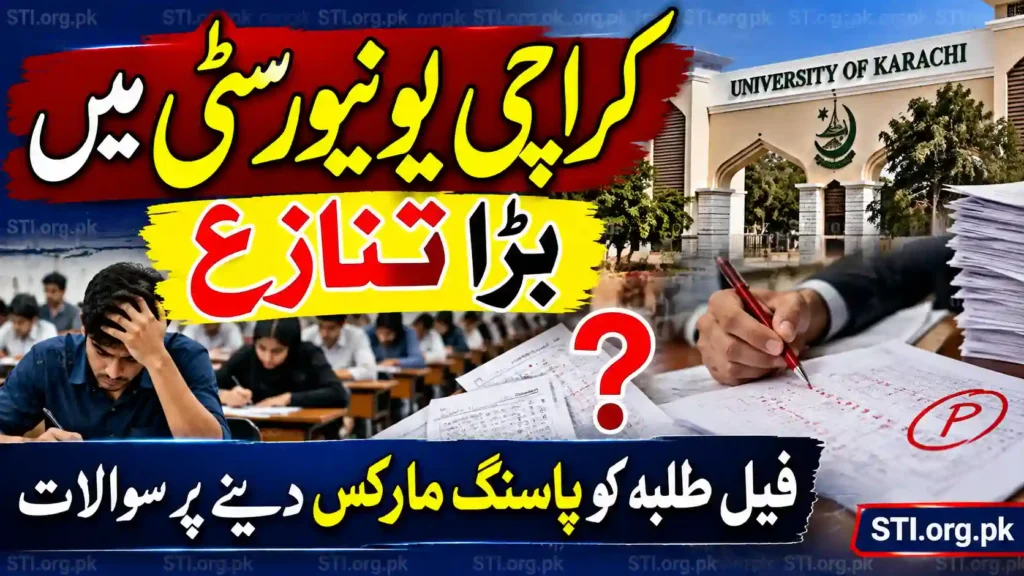
The University of Karachi has come under public scrutiny following reports that around 150 law students who initially failed their examinations were later declared successful after a scrutiny process. The controversy has raised serious questions about examination rules, the transparency of result changes, and the fairness of the university’s assessment system.
According to media reports published in October 2026, the students belonged to S.M. Law College and Islamia Law College, which are affiliated with Karachi University. Some students reportedly failed in subjects including Obligations and Pakistan Studies before their results were revised. The matter has attracted attention from students, education stakeholders, and political groups. However, the allegations require a proper investigation before any wrongdoing can be established. (The Express Tribune, The News)
Karachi University Failed Students Controversy Explained
The controversy began after reports emerged that the examination results of a large number of law students had been changed following a scrutiny exercise. Students who were initially declared unsuccessful were reportedly awarded higher marks in revised results, allowing them to pass subjects they had previously failed.
According to the reports, some students had received zero or very low marks in certain subjects in their original results. After the subsequent process, some reportedly received marks ranging from 50 to 65.
These reported changes have raised questions about how the university reviewed the answer scripts and whether the procedure followed the applicable examination regulations.
The central issue is not simply whether students passed or failed. It is whether the examination result revision process followed the same rules for everyone and whether the changes were supported by proper documentation.

Around 150 Law Students Reportedly Received Revised Results
Media reports have placed the number of students involved in the controversy at around 150. They were reportedly enrolled at S.M. Law College and Islamia Law College and had initially failed in at least two subjects.
The reported changes involved LLB examination results. The scrutiny process reportedly followed recommendations from a committee that included representatives connected with the law colleges and the university’s examination administration.
Reports also state that the process received approval from the then-acting vice-chancellor, Dr. Tufail Jokhio.
These details have increased public interest in the matter. However, the exact circumstances of every student’s result should be examined separately. A change in marks does not automatically prove misconduct, but significant changes require a clear explanation supported by official records.

Why the Scrutiny Process Has Raised Questions
One of the biggest concerns relates to the difference between scrutiny of examination results and rechecking or reassessment of answer scripts.
Scrutiny generally involves checking whether marks have been correctly added, transferred, or recorded. For example, if a student receives marks for several questions, the university may verify whether the total shown on the marksheet matches the marks awarded by the examiner.
Rechecking or reassessment can involve a different process, depending on the university’s rules. It may require examining the answers themselves or reviewing the academic judgment used during marking.
According to reports, former Karachi University vice-chancellor Dr. Khalid Iraqi had previously rejected a proposal concerning a collective request for scrutiny. He reportedly maintained that students were required to submit individual applications and that the annual examination rules allowed recounting rather than rechecking answer scripts.
The key question is whether the later process remained within the university’s permitted scrutiny procedure. The answer should be established by reviewing the applicable rules, committee recommendations, and official approvals.

Role of the University Administration
The reported approval process has placed the university administration under pressure to explain how the revised results were authorised.
Reports indicate that a scrutiny committee met on August 5, 2026, and recommended reviewing certain LLB examination papers. The proposal was reportedly approved the following day.
The committee’s recommendations and the approval process are important because university examination departments must follow established regulations when changing published results.
A transparent process should clearly explain:
- Who requested the review of the results.
- Which examination rules allowed the review.
- Whether students submitted applications according to the required procedure.
- Who examined and approved the proposed changes.
- How the revised marks were calculated and recorded.
- Whether the same rules were applied consistently to all affected students.
Providing these details would help the public understand the decision and reduce uncertainty surrounding the controversy.

S.M. Law College Principal Offers an Explanation
According to media reports, S.M. Law College Principal Professor Fareed Dayo defended the decision, stating that a large number of students had been failed by a teacher associated with Islamia College.
His reported position was that the scrutiny committee provided relief to students who had been treated unfairly.
This explanation introduces another important aspect of the controversy. If students were incorrectly marked, correcting their results could be justified, provided the university followed the proper rules and used a fair review process.
However, claims of unfair marking should also be supported by evidence. The university needs to establish whether the original results contained errors, whether the revised marks were academically justified, and whether the review was conducted according to the applicable regulations.
An independent examination of the relevant documents could help determine whether the changes corrected genuine mistakes or involved an irregular procedure.
Impact on Students and the Education System
The Karachi University examination controversy could affect public confidence in university assessments if the questions surrounding the revised results remain unanswered.
Students spend months preparing for examinations and depend on the results to continue their education, complete their degrees, and pursue professional opportunities. They expect their papers to be assessed according to clear and consistent standards.
If results can be changed without a transparent explanation, students may begin to question the fairness of the examination system. Those who passed through their original marks may also seek clarification about whether the same procedures were available to everyone.
For law students, the issue is particularly important because legal education requires strong knowledge of subjects, careful assessment, and professional responsibility.
At the same time, students who may have been wrongly failed should have access to a fair appeals process. Protecting academic standards does not mean ignoring genuine marking errors. The goal should be to ensure that every student receives a fair assessment under the same rules.
Possible Need for an Independent Investigation
A detailed and impartial investigation could help resolve the matter. The university should review the original marksheets, revised results, examination award sheets, scrutiny applications, committee minutes, and relevant approval records.
The investigation should determine whether the changes were permitted under the university’s examination regulations and whether each affected student’s result was revised on valid grounds.
If procedural violations are identified, the university should take action according to the applicable rules. If genuine errors are confirmed, the administration should explain how those mistakes occurred and how similar problems will be prevented.
An investigation should also provide an opportunity for the officials involved to present their explanations. This would help ensure that conclusions are based on evidence rather than allegations alone.
The university could further improve public confidence by publishing a clear statement explaining the findings, while protecting students’ personal examination information where necessary.
What Karachi University Should Do Next
The university can take several practical steps to address the controversy and strengthen its examination system.
First, clarify the rules: The administration should explain the difference between recounting marks and rechecking answer scripts under the applicable annual examination regulations.
Second, verify every result: Each revised result should be supported by documented reasons and the required approvals.
Third, ensure equal treatment: All students should have access to the same scrutiny and appeals procedures, without preferential treatment.
Fourth, improve record keeping: Original marksheets, revised results, committee recommendations, and approval documents should be properly maintained for audit and verification.
Finally, communicate transparently: A clear official statement would help students, parents, teachers, and the public understand what happened and what action, if any, is required.
These measures could help protect both students’ rights and the credibility of the university’s academic standards.
Karachi University Failed Students Conclusion
The Karachi University controversy over passing marks awarded to failed students has raised important questions about examination transparency, scrutiny rules, and accountability in higher education.
Reports indicate that around 150 law students from two affiliated colleges were initially declared unsuccessful before their results were reportedly revised. Questions have also emerged about whether the scrutiny process complied with university regulations.
At this stage, the allegations should be distinguished from any final finding of misconduct. A fair and evidence-based investigation is needed to establish why the marks changed, whether the rules were followed, and whether any corrective action is necessary.
For Karachi University, the priority should be to provide clear answers, protect students’ rights, and ensure that fair examination practices remain central to its academic system.