
Pakistan has crossed an important education milestone. The Pakistan literacy rate 2026 has risen to 63 percent over the past two years, crossing the 60 percent mark for the first time. According to figures shared by the Pakistan Institute of Education and the Ministry of Education, Punjab leads all provinces, while Balochistan remains at the bottom.
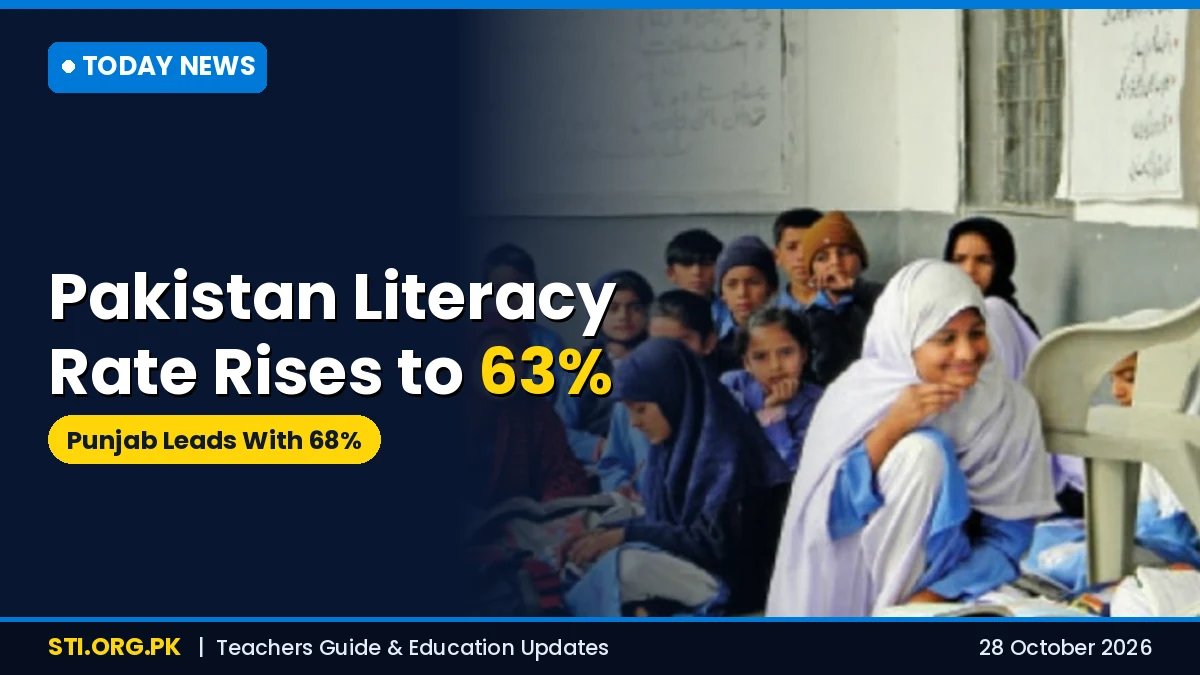
For teachers, these numbers are more than statistics. They show where classrooms are making progress and where much more effort is still needed, especially for girls and rural children.
Also Read: KP Government Schools Repair Plan – 4,049 Schools Need Urgent Work Worth Rs16.2 Billion | Karachi Board Class 11 Result 2026 Announced – Pre-Medical, Science General and Commerce
Province Wise Literacy Rate in Pakistan
Here is the latest province wise literacy rate compared with earlier figures:
| Province | Previous Rate | New Rate |
|---|---|---|
| Punjab | 66.25% | 68% |
| Sindh | 57.54% | 58% |
| Khyber Pakhtunkhwa | 51.09% | 58% |
| Balochistan | 42.01% | About 49% |
| Pakistan (overall) | Below 60% | 63% |
Khyber Pakhtunkhwa shows the biggest jump, rising almost seven percentage points. Balochistan also improved by about seven points, but it is still the lowest in the country.
Also read
Latest News: Punjab University Result 2026 Announced for 32 Exams Including B.Ed and BS Programs
Punjab Literacy Rate Leads the Country
The Punjab literacy rate now stands at 68 percent, with 75 percent of men and 62 percent of women able to read and write. Large-scale teacher recruitment, school outsourcing, enrolment drives and programs like School Teaching Interns (STI) have all been part of Punjab’s education efforts in recent years.
Female Literacy Rate Pakistan: The Biggest Gap
The gap between men and women remains the most worrying part of the data. The female literacy rate Pakistan wide is still far behind male literacy in every province:
| Province | Men | Women |
|---|---|---|
| Punjab | 75% | 62% |
| Sindh | 68% | 47% |
| Khyber Pakhtunkhwa | 73% | 43% |
| Balochistan | 61% | 37% |
In KP, the gap is 30 points, and in Balochistan only about one in three women is literate. Experts say more girls’ schools, female teachers, safe transport and community awareness are needed to close this gap.
Urban vs Rural Literacy
At the national level, urban literacy is around 74 percent, while rural literacy is only about 55 percent. Most out-of-school children live in rural areas, where schools are far away, buildings are weak and teachers are fewer. Pakistan has a total of 342,547 educational institutions, but quality and access still vary widely.
What This Means for Teachers
Teachers are at the centre of improving literacy. The latest literacy rate KP Sindh Balochistan figures show that:
- Basic reading and writing skills must be strengthened in primary classes
- Girls’ enrolment and retention need special attention
- Adult literacy and non-formal education can help older age groups
- Better school facilities and more teachers are needed in rural areas
Questions About the Data
Some education experts and citizens question how literacy is defined, since the basic definition counts people who can read and write simple text. They argue that real learning outcomes, such as reading with understanding and basic maths, should also be measured. Still, the rise above 60 percent shows that enrolment and basic literacy are moving in the right direction.
Pakistan Literacy Rate 2026: How It Was Achieved
Several factors have pushed the Pakistan literacy rate 2026 above 60 percent. Enrolment campaigns, new schools, teacher recruitment, stipends for girls and digital learning tools have all contributed. Provinces have also focused on bringing out-of-school children back to classrooms.
However, the Pakistan literacy rate 2026 figures also remind us that around 37 percent of people still cannot read and write. Reaching the national goal will require steady investment in teachers, classrooms and learning materials over many years.
Teachers can contribute directly by focusing on reading fluency in early grades, tracking absent students, and encouraging parents to keep daughters in school. Small classroom efforts add up and will shape the Pakistan literacy rate 2026 and the years after it.
Frequently Asked Questions (FAQs)
What is the Pakistan literacy rate 2026?
Pakistan’s overall literacy rate has risen to 63 percent.
Which province has the highest literacy rate?
Punjab leads with 68 percent.
Which province has the lowest literacy rate?
Balochistan is lowest at around 49 percent.
What is the urban and rural literacy rate?
Urban literacy is about 74 percent and rural literacy about 55 percent.
Official Source and Related Updates
For official notices and updates, visit the Ministry of Federal Education and Professional Training. Always confirm dates and details from the official source before taking any action.
Also Read: Punjab School Outsourcing Phase 4: What Teachers Should Know
Conclusion: The Pakistan literacy rate 2026 of 63 percent is a positive sign, but the gender and rural gaps show that the job is far from done. Teachers, parents and governments must work together to make every child literate. Follow STI Portal for more education updates.