

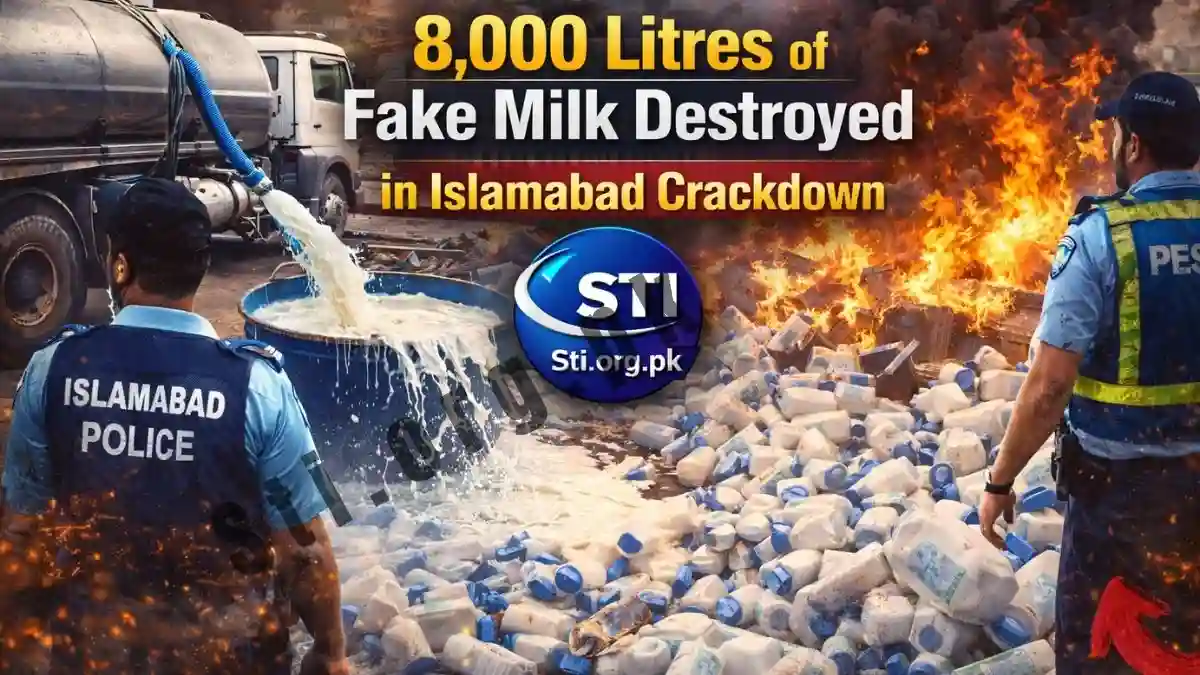
In a major pre-Ramazan food safety crackdown on February 24, 2026, the Islamabad Food Authority and the Punjab Food Authority conducted a joint raid that led to the destruction of 8,000 litres of adulterated milk.
The operation targeted a production facility inside the I-10 Industrial Estate, where authorities uncovered what officials described as a structured and organized counterfeit milk manufacturing setup supplying the twin cities of Islamabad and Rawalpindi.
This was not a small roadside adulteration case. It was an industrial-scale operation.
Here is the complete breakdown of what was found, why it matters, and how consumers can protect themselves.
What Authorities Discovered During the Raid
The so-called milk was not dairy in the traditional sense. Instead, officials described it as a chemically engineered liquid designed to mimic the appearance and texture of fresh milk.
Materials Seized On-Site
Authorities confiscated:
- 336 litres of oil
- 240 kilograms of vanaspati ghee
- 350 kilograms of powdered milk
- Industrial mixing and chilling machinery
The ingredients were being blended to simulate fat content and creaminess typically found in natural milk.
The oil and vanaspati ghee were used to artificially raise fat levels. Powdered milk acted as a base, while chilling units helped achieve a texture resembling fresh dairy.
This mixture was then packaged and prepared for distribution.

Why This Is Dangerous
Adulterated milk poses multiple health risks.
When non-dairy fats and industrial ingredients are mixed without regulated standards:
- Nutritional value declines
- Chemical contamination risk increases
- Digestive issues may occur
- Vulnerable populations face higher risk
Children, elderly individuals, and people with compromised immune systems are particularly susceptible to foodborne complications.
Authorities described the seized product as unsafe for human consumption.

A Pattern Emerging in 2026
This raid is not an isolated case.
According to officials:
- 28 joint operations have been conducted so far in 2026
- More than 22,000 litres of fake milk have been destroyed
The February 24 operation alone accounted for a significant portion of that total.
This indicates a growing regional pattern rather than sporadic violations.

Why Adulteration Surges Before Ramazan
Milk demand increases sharply during Ramazan due to:
- Sehri consumption
- Iftar preparations
- Increased yogurt usage
- Sweet dish preparation
Adulterators exploit this seasonal demand spike.
Late February typically sees a surge in production of counterfeit dairy products in anticipation of Ramazan’s higher consumption levels.
Authorities believe this particular facility was ramping up output to capitalize on the seasonal demand window.

Geographic Shift in Adulteration Networks
Officials highlighted a significant enforcement-driven displacement trend.
Stricter zero-tolerance enforcement in Punjab has pressured illegal networks.
As a result:
- Some production units have shifted operations into Islamabad
- Industrial and residential pockets are being misused
- Cross-jurisdiction coordination has become necessary
This explains the joint nature of the raid between Islamabad and Punjab authorities.
The twin cities are now being monitored through coordinated enforcement strategies.
How the Counterfeit Operation Worked
Based on initial findings, the process involved:
- Mixing powdered milk with water
- Adding oil and vanaspati to mimic fat content
- Using industrial mixers to emulsify the solution
- Chilling the mixture to resemble fresh dairy
- Preparing it for bulk distribution
Without proper pasteurization, hygiene standards, or regulated ingredient ratios, the final product posed serious safety risks.
Public Advisory: How to Detect Synthetic Milk
Authorities issued preventive guidelines for residents of Islamabad and Rawalpindi.
1. Froth Test
When shaken, synthetic milk often produces:
- Excessively stable foam
- Unnaturally thick froth
Pure milk typically produces lighter, less stable froth.
2. Slip Test
Place a drop of milk on a polished slanted surface.
- Pure milk leaves a white streak
- Adulterated or heavily diluted milk flows quickly without leaving residue
While these tests are not scientifically conclusive, they can serve as preliminary warning signs.
3. Report Suspicious Activity
Residents are encouraged to report:
- Suspicious dairy storage
- Unregistered milk supply vehicles
- Unusual production activity in residential areas
Helpline: 1223
Authorities emphasize that public vigilance is critical during high-demand seasons.
Regulatory and Legal Implications
Food adulteration falls under strict food safety and public health regulations.
Penalties can include:
- Heavy fines
- Seizure of equipment
- Business closure
- Criminal proceedings
Authorities indicated that further investigation is underway to identify the broader supply chain linked to the seized operation.
Economic and Social Impact
Beyond health risks, counterfeit milk operations:
- Undermine legitimate dairy businesses
- Distort market pricing
- Damage consumer trust
- Increase healthcare burden
With inflation already affecting essential goods, adulteration compounds consumer vulnerability.
Ensuring safe dairy supply is both a public health and economic stability issue.
Why Joint Operations Matter
The coordinated action between Islamabad and Punjab authorities signals:
- Stronger inter-agency collaboration
- Intelligence sharing
- Unified enforcement approach
- Faster response to cross-border supply chains
Given the displacement of adulteration networks across provincial lines, joint raids are becoming operationally necessary.
What Consumers Should Do During Ramazan
- Purchase milk from reputable suppliers
- Avoid unusually cheap bulk deals
- Check packaging and labeling carefully
- Report irregularities immediately
- Prefer sealed, verified brands when possible
Demand spikes often create space for exploitation.
Awareness reduces risk.
Final Assessment
The destruction of 8,000 litres of adulterated milk in Islamabad marks one of the most significant food safety crackdowns ahead of Ramazan 2026.
Key facts:
- Industrial-scale counterfeit production uncovered
- Oil, vanaspati ghee, and powdered milk used in synthetic mixture
- 28 joint operations conducted so far in 2026
- Over 22,000 litres destroyed this year
- Adulteration networks shifting toward Islamabad
- Public urged to report suspicious activity via helpline 1223
This operation reflects a broader enforcement effort aimed at protecting consumers during a period of high food demand.