

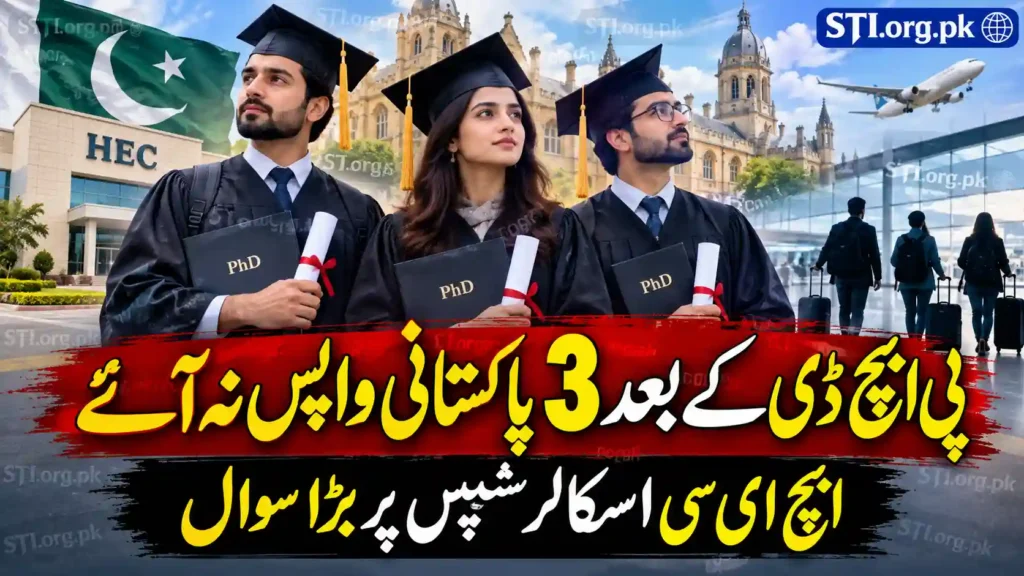
Three Pakistani doctors have come under scrutiny after they failed to return to Pakistan following the completion of their PhD degrees abroad under a scholarship programme funded by the Higher Education Commission (HEC). The issue has raised serious questions about the use of public funds, scholarship agreements, and the responsibility of scholars who receive government support for higher education.
According to a report published on October 15, 2026, the matter was discussed by the Sindh Assembly’s Public Accounts Committee (PAC) during a review of audit observations involving Shaheed Mohtarma Benazir Bhutto Medical University (SMBBMU), Larkana. The committee directed the university to take steps to recover the money spent on the three doctors’ overseas education.
Three Doctors Did Not Return to Pakistan
The case involves three doctors who were selected for overseas PhD studies under an HEC-funded scholarship project in 2016. The programme was designed to support advanced education and improve the skills of professionals who could contribute to Pakistan’s education and healthcare sectors.
University officials reportedly informed the committee that seven doctors had been selected for overseas studies under the project. However, three of them did not return to Pakistan after completing their doctoral programmes.
The three doctors were identified as:
- Dr. Shah Alam Solangi, who studied in China.
- Dr. Zafar Ali Abro, who studied in Germany.
- Dr. Benazir Abbasi, whose study destination was reported as London or Ireland.
The university administration stated that the whereabouts of the three doctors were not known at the time of the committee’s review. The case has therefore become an important issue concerning government-funded PhD scholarships in Pakistan and the enforcement of scholarship conditions.
PAC Orders Recovery of $129,600
The Public Accounts Committee directed Shaheed Mohtarma Benazir Bhutto Medical University to recover approximately $129,600 spent on the three doctors’ education abroad.
This amount represents public money used to support their overseas doctoral studies. The committee also directed the university administration to contact immigration authorities and the relevant embassies to help trace the doctors and support the recovery process.
The decision highlights the government’s concern about ensuring that funds allocated for higher education are used according to the agreed terms.
Scholarships funded by public money are intended to develop skilled professionals, strengthen universities, and improve research in Pakistan. When recipients do not fulfil their contractual commitments, the government may face financial losses and difficulties in achieving the programme’s original goals.
The recovery process will depend on the relevant agreements, available legal remedies, and the outcome of the proceedings involving the university.

What Is the Role of HEC in Overseas Scholarships?
The Higher Education Commission of Pakistan plays an important role in promoting higher education, supporting research, and providing scholarship opportunities to eligible students and professionals.
Through different scholarship programmes, the HEC helps Pakistani students pursue advanced degrees at local and international universities. These opportunities can include financial assistance for tuition fees, living expenses, research, and other approved educational costs, depending on the programme.
An overseas PhD scholarship can help a student access modern laboratories, experienced supervisors, advanced research facilities, and international academic networks.
However, some scholarship programmes also include specific conditions that recipients must follow after completing their studies. These conditions can include returning to Pakistan and serving for a defined period under a signed agreement.
The exact requirements depend on the relevant scholarship scheme and the individual agreement signed by the scholar.
Also read
Master’s Scholarships in Canada for Pakistani Students 2026: Eligibility, Benefits and How to Apply
Why Do Scholarship Agreements Matter?
A scholarship agreement sets out the responsibilities of both the funding authority and the recipient. It explains the conditions under which public money is provided and what the scholar must do after completing the funded education.
For example, certain HEC scholarship programmes require successful candidates to sign a bond agreeing to serve in Pakistan after their studies. The HEC’s published scholarship guidance includes a five-year service obligation for some PhD scholarship schemes.
These requirements should not be treated as identical across all programmes. Students must review the specific terms of their scholarship before accepting an award.
A signed agreement helps protect public funds and establishes clear expectations for scholars who receive financial support.
If a recipient does not meet the conditions, the relevant authority may pursue recovery or other remedies in accordance with the agreement and applicable law.

Public Money and Accountability
The case has renewed attention on accountability in government scholarship programmes. Public funding comes from national resources and should be managed carefully to ensure that it delivers long-term benefits.
When the government funds a student’s education abroad, the expected return is not limited to the student’s degree. The country may also benefit from the person’s research, professional experience, teaching, and contribution to national development.
For universities, the return of trained professionals can help improve academic standards, introduce new research methods, and train future generations of students.
If scholarship recipients do not fulfil their commitments, these expected benefits may be reduced. The funding authority may also have to spend additional time and money pursuing recovery through legal channels.
At the same time, any recovery action should follow due process, and the individuals concerned should have the opportunity to respond through the appropriate legal procedures.
How Can Pakistan Improve Its Scholarship System?
The latest case highlights several steps that could help strengthen the management of HEC overseas scholarship programmes.
1. Better Monitoring of Scholars
Universities and the HEC can maintain updated records of scholarship recipients, their study progress, graduation dates, and post-study obligations. Regular communication can help authorities identify problems before they become long-term cases.
2. Clear Scholarship Conditions
Applicants should receive clear information about service bonds, return requirements, and possible financial consequences before accepting a scholarship.
3. Stronger Recovery Procedures
Where a scholar breaches a valid agreement, the relevant institution should take timely action according to the contract and applicable law. Delays can make it harder to recover public funds.
4. Effective Coordination Between Institutions
Universities, the HEC, government departments, and relevant authorities can coordinate more effectively when a scholarship recipient cannot be contacted or does not meet the agreed requirements.
5. Fair Treatment of Scholars
A strong accountability system should also recognise legitimate circumstances that may affect a person’s ability to return or fulfil an agreement. Each case should be reviewed according to its facts, contractual terms, and applicable law.
Why Overseas PhD Scholarships Are Important for Pakistan
Despite concerns about scholarship compliance, foreign PhD scholarships for Pakistani students remain important for national development.
Advanced education can help Pakistan improve medical research, engineering, agriculture, information technology, and other important fields. International study also allows scholars to learn new methods and develop professional relationships with researchers around the world.
When graduates return and apply their knowledge locally, universities and public institutions can benefit from improved teaching, research, and innovation.
For this reason, the solution is not to discourage deserving students from pursuing education abroad. Instead, scholarship programmes should combine educational opportunities with transparent rules, effective monitoring, and fair enforcement of agreements.
What Happens Next in the Three Doctors’ Case?
The university has been directed to pursue the recovery of the funds spent on the three doctors’ overseas PhD programmes. The committee also instructed the administration to contact immigration authorities and relevant embassies to help trace them.
The recovery process is subject to the applicable legal procedures. According to the published report, the university had already filed a court petition, and the proceedings were pending.
The final outcome will depend on the court process and the steps taken by the concerned authorities. No final recovery should be assumed until the relevant action is completed.
The case also serves as a reminder for future scholarship applicants to read every condition carefully and understand their responsibilities before accepting public funding.
Pakistani Doctors PhD Abroad Conclusion
The failure of three Pakistani doctors to return after completing their PhDs under an HEC-funded scholarship programme has raised important questions about public money, overseas education, and scholarship accountability.
The Sindh Assembly’s Public Accounts Committee has ordered Shaheed Mohtarma Benazir Bhutto Medical University to pursue the recovery of $129,600 and coordinate with relevant authorities to trace the doctors.
The case demonstrates the importance of monitoring publicly funded education programmes and enforcing valid scholarship agreements fairly. Pakistan needs skilled professionals who can use their international education to strengthen national institutions. At the same time, scholarship programmes must protect public resources and ensure that recipients understand and fulfil their contractual responsibilities.